
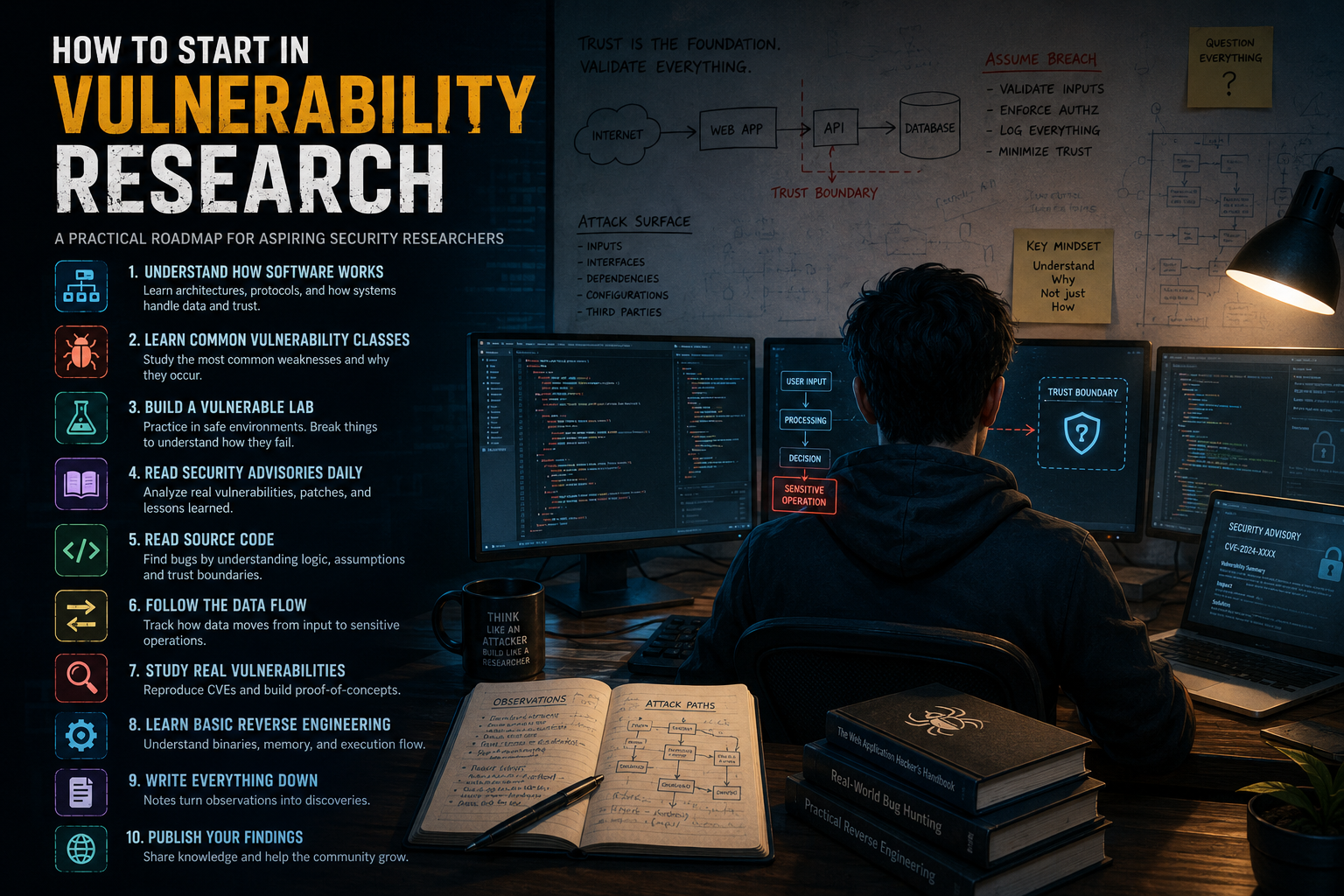
Understanding How Security Research Really Begins
Many newcomers believe vulnerability research starts with advanced exploit development, reverse engineering malware, or discovering zero-day vulnerabilities.
In reality, most successful vulnerability researchers begin somewhere much simpler:
They develop the ability to understand how software behaves when developers make assumptions that attackers can violate.
Vulnerability research is fundamentally the study of trust, assumptions, boundaries, and unexpected behavior.
The objective is not to “hack things.”
The objective is to understand systems deeply enough to recognize when reality differs from what developers intended.
What Is Vulnerability Research?
Vulnerability research is the systematic process of identifying security weaknesses in software, protocols, hardware, cloud environments, APIs, mobile applications, and operating systems.
Researchers seek to answer questions such as:
- What assumptions does this system make?
- What input is considered trusted?
- What happens when those assumptions fail?
- Can an attacker influence behavior?
- Can trust boundaries be crossed unexpectedly?
- Can security controls be bypassed?
A vulnerability exists when attacker-controlled behavior causes security properties to fail.
Those properties may include:
- Confidentiality
- Integrity
- Availability
- Authentication
- Authorization
- Non-repudiation
Step 1: Learn How Software Actually Works
Before learning exploitation, learn software architecture.
A surprising number of vulnerability researchers spend more time reading code than writing exploits.
Focus on understanding:
Web Applications
- HTTP
- Cookies
- Sessions
- JWTs
- REST APIs
- GraphQL
- Authentication flows
Backend Systems
- Databases
- Queues
- File systems
- Caching systems
- Cloud services
Programming Languages
Start with one language:
- JavaScript
- Python
- Go
- Java
- PHP
Do not attempt to learn everything simultaneously.
Understanding one ecosystem deeply is more valuable than understanding many superficially.
Step 2: Learn Common Vulnerability Classes
Most modern vulnerability research starts with understanding known failure patterns.
Examples include:
| Vulnerability | Description |
|---|---|
| SQL Injection | User input reaches database queries |
| Cross-Site Scripting (XSS) | Attacker-controlled content reaches browsers |
| SSRF | User input influences outbound requests |
| Path Traversal | File paths escape intended directories |
| Command Injection | User input reaches operating system commands |
| Authentication Bypass | Security decisions fail unexpectedly |
| Deserialization Issues | Untrusted objects influence execution |
| Access Control Flaws | Users access resources they should not |
Learn why these vulnerabilities happen.
Do not focus only on payloads.
Payloads change.
Failure patterns remain.
Step 3: Build A Vulnerable Lab
Research is learned through experimentation.
Create intentionally vulnerable environments.
Examples include:
OWASP Juice Shop
Excellent for:
- Authentication flaws
- XSS
- API abuse
- Business logic issues
DVWA
Excellent for:
- SQL Injection
- File Inclusion
- Command Injection
Node.js Labs
Build your own:
- Express applications
- JWT authentication
- File uploads
- Database queries
This approach teaches significantly more than reading writeups.
Step 4: Read Security Advisories Every Day
Many researchers underestimate this step.
Public advisories are one of the best learning resources available.
Study:
- CVEs
- GitHub Security Advisories
- Project security releases
- Vendor advisories
Ask:
- What failed?
- Why did it fail?
- What assumption was violated?
- How was it fixed?
The patch is often more educational than the vulnerability itself.
Step 5: Learn To Read Source Code
The transition from beginner to researcher usually happens when source code becomes readable.
Start with:
- Open source projects
- Security patches
- Pull requests
- Commit diffs
Look for:
- Missing validation
- Unsafe assumptions
- Dangerous trust transitions
- Authorization decisions
- User-controlled input
Many vulnerabilities become obvious once you learn where to look.
Step 6: Follow Data Flow
Modern vulnerability research often focuses on data movement.
Track:
Input → Processing → Decision → Sensitive Operation
Example:
User Input
↓
API Request
↓
Backend Logic
↓
Database Query
↓
Privilege Decision
Researchers constantly ask:
“Can attacker-controlled data reach a sensitive operation?”
This mindset reveals vulnerabilities that scanners frequently miss.
Step 7: Study Real Vulnerabilities
Avoid spending all your time on theoretical material.
Reproduce public vulnerabilities.
Examples:
- Axios header leakage
- JWT key confusion
- Path traversal issues
- SSRF vulnerabilities
- Open redirect flaws
- Dependency supply chain attacks
Build small proof-of-concepts.
Observe behavior directly.
Nothing accelerates learning faster.
Step 8: Learn Basic Reverse Engineering
Eventually you will encounter software without source code.
Useful skills include:
- Reading assembly basics
- Using debuggers
- Understanding memory layout
- Following execution flow
Useful tools:
- Ghidra
- IDA Free
- x64dbg
- GDB
Do not rush into advanced exploit development immediately.
Focus first on understanding program behavior.
Step 9: Write Everything Down
Professional researchers maintain notes.
Document:
- Observations
- Failed attempts
- Interesting code paths
- Security assumptions
- Potential attack paths
Research quality often depends more on documentation than technical brilliance.
Many discoveries occur when connecting observations made weeks earlier.
Step 10: Publish Your Findings
Publishing accelerates learning.
Write:
- Research notes
- Technical blogs
- Vulnerability analyses
- Advisory summaries
- Proof-of-concept explanations
Teaching forces clarity.
Clarity improves research.
Common Beginner Mistakes
Chasing Zero-Days Too Early
Most researchers should spend months understanding existing vulnerabilities before searching for unknown ones.
Focusing Only On Tools
Tools help.
Understanding creates discoveries.
Memorizing Payloads
Payloads are not the research.
Understanding why they work is the research.
Ignoring Software Engineering
Many great vulnerability researchers are excellent software engineers.
The better you understand software construction, the better you understand software failure.
Recommended Learning Path
Year 1:
- HTTP
- APIs
- Authentication
- OWASP Top 10
- JavaScript or Python
- Vulnerable labs
Year 2:
- Source code review
- Open-source research
- CVE analysis
- Static analysis
- Dynamic testing
Year 3:
- Protocol analysis
- Reverse engineering
- Binary research
- Exploit development
- Original vulnerability discovery
Final Thoughts
Vulnerability research is not about finding bugs.
It is about understanding systems.
Researchers who focus exclusively on exploits often struggle to grow.
Researchers who focus on architecture, trust boundaries, software behavior, and data flow eventually discover vulnerabilities naturally.
The best researchers are not necessarily the best hackers.
They are often the people who understand how systems were designed, how they actually behave, and where those two realities diverge.